Is Spaceflight Too Expensive?

“Space is too expensive. We should spend the money on problems on Earth.”
This is a common refrain that I’ve heard over time and it is worth addressing. Primarily because what we spend on things is a reflection of our values, and also because many people who make these comments don’t seem to know what we have historically spent on human spaceflight and also don’t know how that compares to other things that we spend money on.
Also, it is worth considering how much in funding cuts are being proposed to agencies like NASA, NIH, NSF, NOAA, and others.
First, how much do we actually spend on civilian spaceflight like NASA?
To get some idea of how NASA stacks up on an agency by agency basis, check out the graph below:
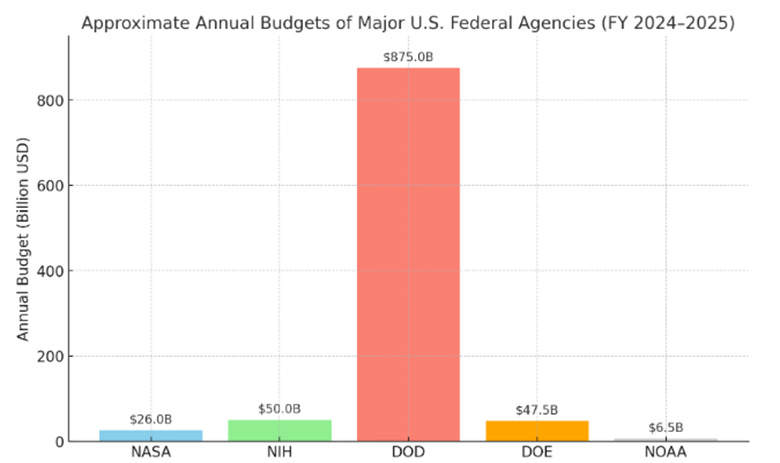
The total NASA budget for years has been around $26B annually. The graph above puts into stark contrast where the bulk of your tax dollars goes among some major federal agencies. And before anyone gets upset, I’m just looking at a sampling of science funding agencies, not at the role of entitlements. If you want to see an in-depth budget analysis including Medicaid, social security, and lots of other things, I invite you to go start your own substack.
Note that the DOD makes up the largest portion of the budget at almost $900B. By far. This is as much as the next 9 countries spend combined (https://www.pgpf.org/article/the-united-states-spends-more-on-defense-than-the-next-9-countries-combined/) Some of it is spent on science. The VA typically spends about $984M on science. AFOSR spends about $450M annually. And there are other science offices in the military. The point is that when people attack NASA’s budget, just realize that you are attacking a pittance of what is spent on the military in the US, and I might humbly suggest that better savings can be found elsewhere without gutting the premier civilian space science and exploration agency in the world. We will get into some more of the numbers below, but for now let’s touch on the proposed budget cuts this year.
The president’s proposed budget would cut NASA from $26B to $19B and remove an awful lot of science. If you look closely, they plan to move a lot of money into human spaceflight, but I don’t celebrate this as a victory. Why not? Because besides killing things like the SLS (which probably needs to die) and Gateway (which probably should not be killed), the budget eviscerates a lot of science that is tied to what it means to be human and to understand our place in this universe.
First, Earth science is extremely important as we head into this time of worsening climate uncertainty. Killing Earth science is a transparent move by those sympathetic to the fossil fuel industries to remove the ‘data’ that people can point to when arguing that we need to phase out fossil fuels. This is the ostrich approach, and sticking our head in the sand isn’t going to make the problem go away. It is just going to make us less prepared to deal with the extreme weather events that are coming with more frequency now.
Heliophysics is understanding how the sun works. In case you hadn’t noticed that’s the big ball of nuclear fusion at the center of the solar system that is the source of most energy that powers life on Earth. It is also the source of solar particle events that can knock out our power grids, create the auroras, and hurt astronauts without sufficient protection in space. Cutting the small amount of funding currently going here will not help anyone.
Space Biology is also funded through the Science Mission Directorate. This is the premier group working on cellular and molecular research in space. Things like understanding how animal and human biology changes in spaceflight. All of the genomics, epigenomics, proteomics, etc. work done at NASA is done here. Not at the Human Research Program interestingly. And yet we as humans have DNA, genes, an epigenome, etc. The fact that these two scientific research areas are separated by NASA centers (and their politics) is a bummer. But when we talk about understanding how humans respond to microgravity, isolation, radiation – all the things involved in a Mars mission, an important part of that is understanding these changes at the cellular and molecular levels. This helps us identify things like pharmaceutical targets to help us tolerate the challenges of the spaceflight environment better. It also helps us identify places where the biological changes of spaceflight are similar to Earth-based diseases. Things like osteoporosis, muscle atrophy, mitochondrial changes, and more. All this to say that Space Biology is intimately tied to human spaceflight, so if someone has a goal to improve human spaceflight, they should also have a goal to increase funding in space biology.
Historical spending
We started spending serious money on human spaceflight during the Apollo era, and at that time we spent about 4% of the total federal budget on NASA, mainly for beating the Soviets to the moon. After that, the percentage of the federal budget we spent on NASA overall dropped down to about 0.4% of the total federal budget.
Here’s a link to the NASA budget over time: https://ourworldindata.org/grapher/nasa-annual-budget.
But that isn’t adjusted for inflation. The more meaningful chart is one that shows it adjusted for inflation. There’s a great walkthrough of the NASA budget at the Planetary Society website (https://www.planetary.org/space-policy/nasa-budget) that is the source of the next few graphs.
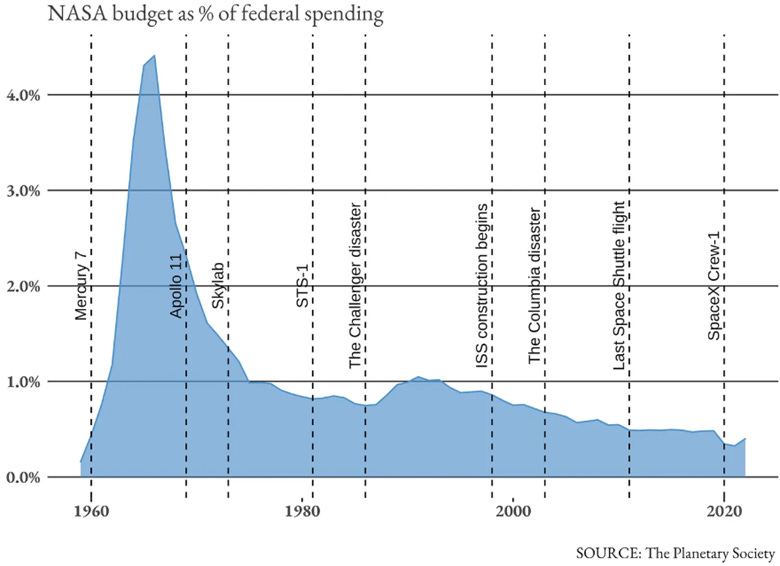
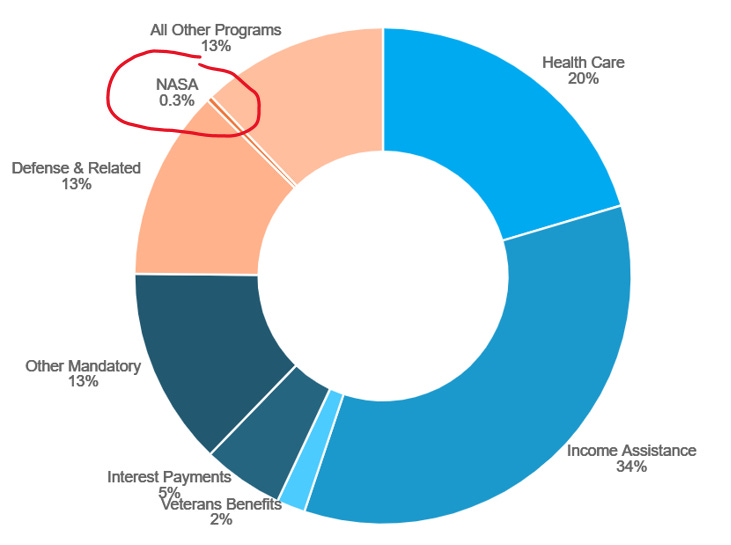
From the year 2020, this graph shows how much federal spending on NASA in comparison with other categories of the federal budget:
It is also important to note that the money we do spend on NASA is not all spent on human spaceflight. There are a lot of other things that the budget goes towards as shown in this graph from the Planetary Society:
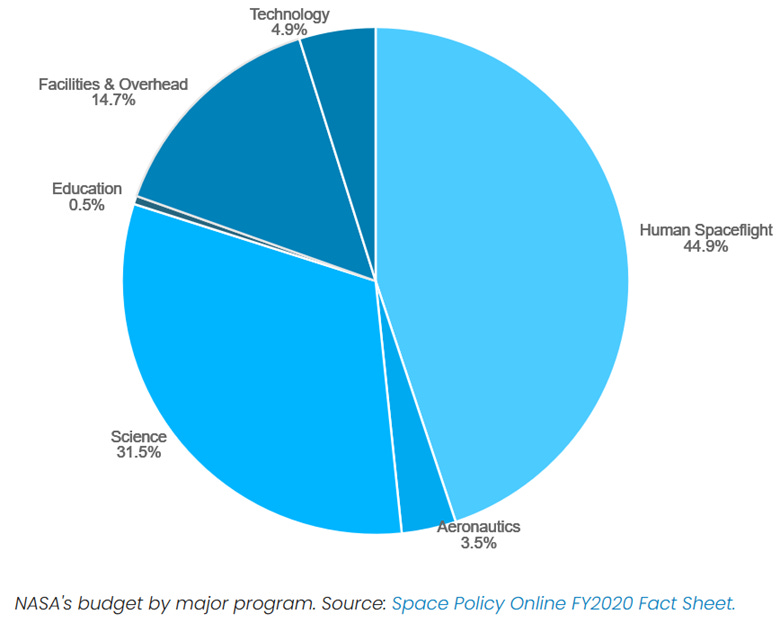
These numbers are a little old, but close enough to make the point. NASA’s total budget is around 0.4% of the federal budget, and less than half of that gets spent on human spaceflight. So less than 0.2% of federal spending is directed towards human spaceflight. Around $12B.
Are we spending too much on NASA? That’s a value judgement for you to make. But I want to make sure you have sufficient knowledge to make that judgement.
My feeling is that the amazing science, engineering, education, and human spaceflight that NASA does are extremely good investments on our part, and small compared to other things that we spend on. Let’s face it, the US has the world’s premiere space program, hands down. These days China is catching up, but no place else in the world has spent anywhere near as much money as we have. This includes Russia, Europe, Canada, and Japan. Nor do they have the infrastructure or experience base that we do with human spaceflight. And it is civilian infrastructure, not military! With a requirement to educate the people of the United States. If you have not looked around the NASA Spinoff page (https://spinoff.nasa.gov/), it is well worth your while to see how NASA technology development for space has influenced other industries.
Also to note, from the recent NASA economic report, NASA generated around $75.6B in economic activity in the US with all states benefitting (https://www.nasa.gov/news-release/new-report-shows-nasas-75-6-billion-boost-to-us-economy/). So we input $26B and got $75.6B back. Not bad.
So, is human spaceflight too expensive? Again, this is a value judgement that you need to make. Our tax dollars go a lot of places, but as the graphs and information above show, the investment in NASA and human spaceflight is a tiny fraction of the federal budget and it pales in comparison to things like Department of Defense spending. If you think we should be re-assessing our priorities, so do I! If you think reallocating the NASA budget is going to ‘fix’ any of those problems, I’d humbly suggest that it probably won’t achieve what you are hoping for.
I think we're currently seeing the result of a sustained lack of public education about these agencies. The media is partially to blame as they hype private companies for the science government agencies make possible but somewhere in the oughts the government really stopped educating the public about what it is they do. We see evidence of this with the NOAA and NWS cuts. Average citizens just don't know what research is being done and how it affects them. I'd like to see some clever PR campaigns for each of these like the FB accounts for the NPS but more broadly accessible.
A good analysis. What NASA does best is pure research. That's where they need to spend most of their money on. When It comes to human space flight, though, there's too much waste and inefficiencies. Unfortunately, most of the crewed space projects like SLS are based upon the whims of Congress, because government money flows into specific states to keep certain folks employed. It doesn't matter whether they actually produce a product or not. That is why NASA should outsource that type of work to the commercial sector.